ServicesWater Softeners
Water Softeners in Waukesha
Hard water leaves calcium and magnesium scale inside your water heater, faucet cartridges and dishwasher. We install and service softeners sized to your hardness and daily water use, then set the regeneration schedule so the resin, the control valve and everything downstream last as long as they should.
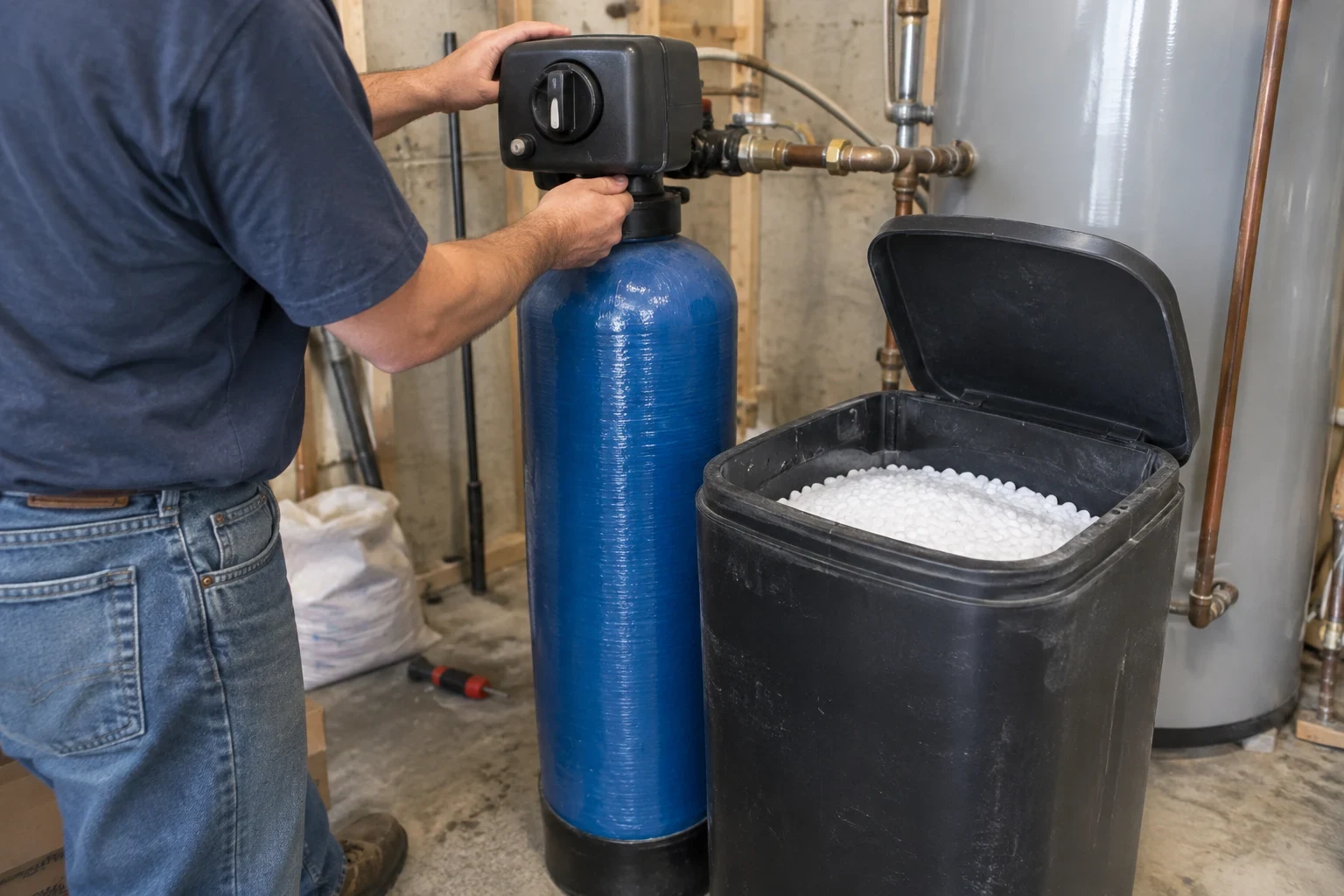
What a softener does and when it makes sense
A softener works by ion exchange. Inside the mineral tank is a bed of small resin beads charged with sodium or potassium. As hard water flows past, the beads trade those ions for calcium and magnesium and hold the hardness. Once the bed is saturated, the control valve starts a regeneration: it pulls brine from the salt tank, recharges the beads and rinses the captured minerals to the drain.
It is worth doing when scale is costing you: a water heater that rumbles, crusty aerators, spotted glasses, soap that will not lather. Groundwater across southeast Wisconsin moves through limestone and dolomite, so hardness is common in homes on wells and in many older systems. If taste, odor or chlorine is what bothers you, a softener will not solve it, and whole-home filtration or reverse osmosis is the better place to look.
What our softener work includes
Sizing by grain capacity
We match the unit to your hardness figure, the size of your household and the fixtures in your home. Too small a tank regenerates constantly and wears out the valve; too large a tank leaves resin idle long enough to channel.
Metered, demand-based valve setup
The control valve is programmed to regenerate after a set number of gallons, not on a fixed clock. You use less salt and water, and the seals and pistons see fewer cycles.
Bypass valve and proper drain
Each install includes a bypass, so the softener can be taken offline while the rest of your home keeps running water. The drain line ends at an air gap, an open break that stops drain water from being pulled back into the softener.
Service on existing softeners
We clean out brine tanks, break up salt bridges, clear plugged injectors and replace worn seals and spacers. If the resin is fouled or the valve cannot be saved, we say so and show you the reason.
Iron and chlorine protection
Iron coats the resin beads and chlorine wears them down over time. When either shows up in your water, we talk through a prefilter that keeps the resin bed working longer.
Signs your home needs a softener or service
White crust on fixtures
Scale on showerheads, aerators and glass shower doors means calcium is getting through. The same buildup is forming inside pipes and appliances out of sight.
A noisy or slow water heater
Popping and rumbling come from scale and sediment on the bottom of the tank. That layer sits between the water and the burner or element, so heating takes longer and uses more energy.
Salt that never goes down
When weeks pass and the salt looks untouched, a salt bridge is the usual cause: a hard shell that keeps water from reaching the salt below. The softener keeps regenerating with plain water, which does nothing to the resin.
Hard water came back
A softener that once worked and now lets spots and scale through usually has a plugged injector, a leaking valve seal or worn-out resin.
Dry skin and dull laundry
Calcium and magnesium react with soap and leave a film on skin and fabric. Softened water rinses clean and needs less detergent.
How a softener job runs
- 1
Phone call
Describe the scale, spotting or softener trouble you have noticed and roughly how many people use water in your home. We give you a free quote and go over financing information if you want to pay over time.
- 2
Look at your plumbing
We find where the main line comes in, whether a softener loop is already there and where the nearest drain and outlet sit. Those details set the placement and any plumbing work.
- 3
Install day
We turn off the water, take out any old unit, plumb in the bypass, run the drain to an air gap and set the brine tank. Water is usually back on through most of your home within a few hours.
- 4
Programming and walkthrough
We load the resin, enter your hardness and capacity on the valve and run a manual regeneration while watching each fitting under full pressure. Before we pack up, you learn to read the display, pick the right salt and recognize a bridge forming in the brine tank.
What moves the price of a softener
There is no flat number, because your quote depends on your water and your plumbing. We write it out line by line, and the price holds for 30 days. Nothing is paid until the install is finished, when the full amount is due. If you would rather spread it out, U.S. Bank Avvance offers financing on approved credit.
- Grain capacity and valve
- A bigger resin tank with a metered valve costs more up front than a small timer model. It also regenerates less often, so it burns less salt and puts less wear on its seals year after year.
- Plumbing changes
- If your home already has a softener loop near a floor drain, the job is simple. New supply lines, a new drain run or moving the unit to a better spot add labor and parts.
- Removing the old unit
- Pulling out an old softener and hauling it away takes time, and corroded fittings around it sometimes need to be cut out and replaced.
- Prefilters and add-ons
- A sediment or carbon prefilter ahead of the softener shields the resin from iron or chlorine, but it is extra equipment on the quote.
Water softener questions
Something not covered here? (262) 710-2091
Will softened water taste salty?
For most homes, no. The amount of sodium added tracks the amount of hardness taken out, and at ordinary levels few people notice it. If you want to avoid it, most softeners run fine on potassium chloride, or a reverse osmosis system can supply the kitchen tap.
Should I repair my old softener or replace it?
That comes down to what failed. Worn seals, a plugged injector or a brine tank problem are usually worth fixing. When the resin is fouled and the valve is cracked or no longer supported, replacing the unit often costs less over its life, and we show you what we found so you can decide.
What salt should I use and how often do I add it?
High-purity pellets or solar crystals leave less sludge than rock salt and bridge less often. Lift the brine tank lid roughly every four weeks, and when the salt has dropped below a third of the tank's height, add more. Stop well short of the rim, because salt packed to the top is more likely to crust over.
Does a softener remove iron or well water problems?
A softener can take out a small amount of dissolved iron, but heavy iron, a sulfur smell or sediment will foul the resin. Those homes are better served by the equipment on our well water treatment page, sometimes with a softener after it.
Can I change my mind after signing?
You can. Once you sign, you still have three business days to cancel. Before that, your quote stays good for 30 days, which gives you room to think it over and compare.
Protect your water heater and fixtures
A properly sized softener with a sensible regeneration schedule saves salt, water and wear on everything it feeds. We serve Waukesha, Brookfield, Pewaukee and the surrounding area.